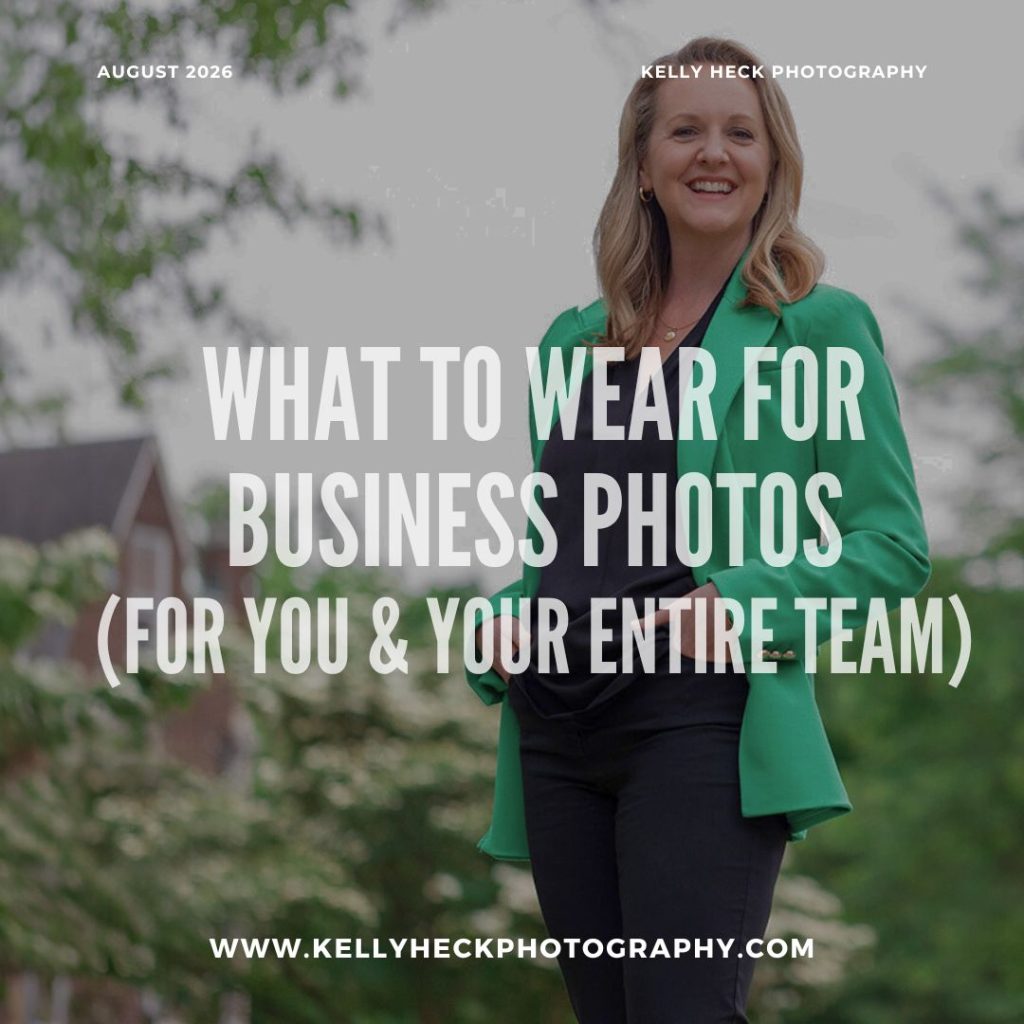
The wardrobe guide every company needs before a branding, portrait, or headshot session.
First Things First: You Should Still Look Like YOU
One of the questions I hear most before a business photo session is:
“What should I wear?”
And while I have plenty of suggestions (my personal clients get the exclusive KHP prep guide), my first piece of advice is pretty simple:
Dress like yourself.
Your professional photos shouldn’t turn you into some generic version of a “business person.” They should look like you on a really good day.
If you’re a suit-every-day person, fantastic. Wear the suit.
If your everyday work uniform is jeans, boots, and a button-down, don’t suddenly put yourself in a three-piece suit because someone told you that’s what a professional headshot is supposed to look like.
And if you’re known for fabulous glasses, bright colors, statement jewelry, funky shoes, or a signature pink blazer? PLEASE don’t leave your personality at home.
The goal is polished, confident, approachable, and authentic to the way you actually show up in your business.
1. YES, You Can Wear Color!
I love color.
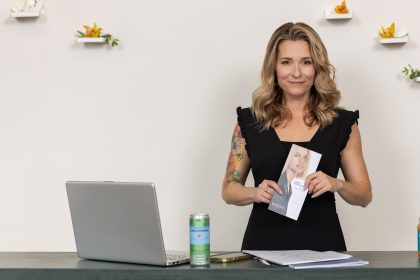
And contrary to a lot of traditional headshot advice, bright, vivid, saturated colors can photograph BEAUTIFULLY.
Rich blue. Emerald green. Hot pink. Red. Orange. Yellow. Purple. Jewel tones. Bring them on.
What matters isn’t whether a color is “bold.” What matters is whether it:
- Looks great on you
- Works with the planned background or location
- Makes sense for your brand and personality
- Doesn’t create an unwanted color cast on your skin
- Plays nicely with everyone else if we’re photographing a group
Neutrals are wonderful too. Navy, charcoal, cream, black, white, camel, gray, and earth tones can create beautiful, timeless portraits.
But neutral does not automatically mean more professional.
What about your brand colors?
Your brand palette can be a wonderful jumping-off point, but you do not need to literally dress in your logo colors.
Sometimes incorporating a brand color into clothing makes perfect sense. Other times it’s better brought in through the background, environment, accessories, props, or simply the overall color palette of the finished images.
And sometimes your bright blue shirt against your company’s orange branding is exactly the pop we need.
This is part of why we plan.
2. Solids Are Easy — But Patterns Aren’t Forbidden
Solid colors photograph beautifully and are usually the easiest choice, especially for a traditional headshot.
But I’m not going to tell you patterns are off limits.
A great pattern can add personality, texture, and visual interest to a portrait. Florals, plaids, geometric patterns, stripes—they can all work.
There is one technical consideration: very tiny, tightly repeating patterns can sometimes create a weird visual effect called moiré on camera. Fine pinstripes and very small checks are common offenders.
Otherwise, the bigger question is simply:
Is your clothing adding something to the portrait—or stealing all the attention?
Texture is also fantastic. Knits, linen, denim, layered fabrics, jackets, sweaters, and other tactile materials can add dimension without competing with your face.
3. Fit Matters More Than the Price Tag
You do NOT need to go shopping for an expensive new outfit.
You do need something that fits you well.
Clothing that pulls, bunches, gaps, rides up, collapses around the collar, or requires constant adjusting will probably annoy you during the session—and you’ll see some of those issues in the photographs too, no matter how “on it” we are.
Try your outfit on ahead of time.
Sit down in it.
Cross your arms.
Move around.
Look at yourself from the front and the side.
Make sure you feel good in it.
Do a little dance, if you dare.
And please, please, please check for wrinkles.
A $40 shirt that fits beautifully and has been freshly steamed will photograph better than a $400 shirt that doesn’t.
Pro tip: If you’re debating between two outfits (or ten), bring both! I’m always happy to help.
4. Dressing a Team? Coordinate — Don’t Clone Everybody.
Please don’t put your entire staff in identical shirts unless matching apparel is authentically part of your brand or uniform.
For most teams, we’re looking for cohesion, not matching.
Instead, think about the overall level of dress.
Are we going:
- Traditional corporate?
- Business casual?
- Relaxed and approachable?
- Creative?
- Rugged/industrial?
- Medical?
- Hospitality?
- A mixture that accurately represents the different roles within your company?
You can also give everyone a loose color family if it makes sense: blues and neutrals, jewel tones, warm earth tones, company colors, etc.
But I actually LIKE having some visual variation in a group.
Different colors, textures, jackets, necklines, and layers create dimension. We want everyone to look like they belong to the same company.
5. Think About Where the Photos Will Be Taken
Wardrobe doesn’t exist in a vacuum.
Before your session, I’m thinking about you + your clothing + your background + your brand + where these photographs need to live.
A dark jacket may disappear against a dark background—or that might be exactly the dramatic look we’re going for.
A bright color can absolutely sing in an industrial space.
White can look incredible outdoors.
A company uniform may make much more sense than business attire when we’re photographing someone in their actual work environment.
There aren’t many universal wardrobe rules because context matters.
This is also why sharing outfit ideas with me before the session is always welcome. Send me a quick photo from your closet. I would much rather help you decide beforehand than have you standing in front of the camera wondering if you chose the wrong thing.
6. Layers Give Us Options
Jackets, cardigans, overshirts, sweaters, scarves, vests, and other removable layers are fantastic because we can create multiple looks without requiring a complete wardrobe change.
A blazer on and blazer off can turn one outfit into two very different portraits.
For a personal branding session, I often recommend bringing several pieces so we can vary the level of formality throughout the shoot.
You might want:
The polished version.
The approachable version.
The let’s-get-to-work version.
And the one that just feels completely YOU.
Those photographs serve different purposes—and that’s valuable.
7. Don’t Forget the Little Things
A few things worth checking before you walk out the door:
- Are your glasses clean?
- Is there pet hair on your jacket?
- Did you remove the hair tie from your wrist?
- Are your pockets full of keys and phones?
- Is your collar sitting correctly?
- Are your clothes wrinkled?
- Is your jewelry sitting where it belongs?
- If your shoes will be photographed, are they photo-ready?
- Are your undergarments fitting correctly and indiscernible once dressed fully?
- Did you pluck the pesky whiskers from your chin, nose, ears, and eyebrows? Yes, I’ll see those, LOL!
And if you’re wearing a uniform, lab coat, safety vest, branded polo, apron, or other workwear, bring the cleanest, newest-looking version available.
The camera sees details. And the studio lighting highlights them.
8. Hair, Makeup & Grooming: Look Like Yourself
This is another area where I don’t believe in reinventing yourself for picture day.
If you normally wear makeup, wear the makeup that makes you feel fantastic. Pro photo tip: Be cautious with very dewy, luminous, or reflective makeup products. Studio lighting—and even bright natural light—can amplify that sheen, creating overly shiny areas or bright hotspots on the skin. A natural or soft-matte finish generally photographs beautifully, and you can always add a little glow and/or gloss intentionally where you want it.
If you don’t normally wear makeup, you certainly don’t need to start because you’re having professional photographs taken.
Wear your hair the way you like your hair.
Keep your beard if your beard is part of you.
Wear your glasses if people know you in glasses.
You should be recognizable!
The goal is simply to arrive feeling fresh and prepared… and maybe even slightly enhanced. Give yourself enough time that morning that you aren’t rushing through the door already frazzled.
And maybe don’t experiment with a brand-new haircut, spray tan, facial treatment, or completely unfamiliar beauty routine the night before your session.
Picture day is not the day for surprises.
9. What Should You NOT Wear?
I don’t have a giant list of wardrobe commandments.
I would be cautious about:
- Extremely tiny repetitive patterns that may cause moiré
- Clothing that wrinkles the second you look at it
- Distracting logos or text that aren’t relevant to your brand
- Clothing you constantly have to tug, straighten, or adjust
- Anything uncomfortable
- Anything that doesn’t actually feel like you
That’s about it.
I’m not going to tell you that executives can’t wear pink, creatives can’t wear suits, women can’t wear sleeveless tops, or everyone needs to show up in navy.
There is no single uniform for looking professional.
10. The Most Important Thing You Can Wear Is Confidence
I know. Cheesy photographer line.
But it’s TRUE.
Nearly everyone starts a photo session by telling me some version of:
“I hate having my picture taken.”
And that’s okay.
You don’t need to know how to pose. You don’t need to know what to do with your hands. You don’t need to practice your smile in the mirror.
That’s my job.
Your job is to show up in something that makes you feel comfortable, capable, and like yourself.
We’ll take care of the rest together.
Planning Photos for an Entire Company?
If you’re coordinating headshots, leadership portraits, personal branding, or a larger corporate photography session, wardrobe is something we can talk through before anyone steps in front of my camera.
We’ll consider your brand, your people, your location, how the photographs will be used, and what level of consistency actually makes sense.
And if someone on your team is staring into their closet thinking, “I have absolutely no idea what Kelly wants me to wear…”
Send me a picture.
Seriously.
I’d rather answer the question.
Great business photography isn’t about making everybody look the same. It’s about making everyone look like the very best version of themselves—and making the finished collection feel unmistakably like your company.
Ready to update your professional photos? Whether you need a fresh headshot, a personal branding library, or cohesive photography for your entire team, we’ll plan the details together—from wardrobe and location to the final images your business actually needs. Let’s create photographs that look polished, professional, and most importantly, like YOU. LET’S PLAN YOUR PHOTO SESSION!